
Put understanding into practice
This workbook helps you use ChakraKey in situations where thought, feeling, desire and responsibility pull in different directions. Its purpose is to turn self-understanding into choices that you can practice, review and improve.
The central teaching is that energy follows thought. Thought directs attention; the heart receives and gives energy to our expression. We grow our capacity for loving outcomes by expanding what we know, examining what we imagine, and choosing how to act.
Work with one real situation
Choose an ordinary challenge: a conversation, a habit, a decision, an unfinished idea or a shared responsibility. Carry it through the exercises. Write enough to become specific. You can repeat a useful page whenever a new situation arises.
Learn from the result
Intention matters, and so does impact. After acting, ask what happened, how others were affected and what you now understand. Another person’s response is information for your next choice, not something you can command through thought. This workbook provides teaching and practice pages. Current guided lessons, course access and Life Coach training details are available from Rick; they are not included automatically with this file.
My name and the situation I want to work with
Your practice pathway
Attention and the heart
Your full spectrum
Symbols and connections
Your connection to Mother Nature
The six Compass directions
Thoughts and creative gifts
Love in action
Continue your practice
4
8
12
15
18
22
26
30
Keep a working record
Date the pages you use. Describe actions and observations clearly enough that you can compare them later. “I asked one question and listened to the answer” will teach you more than “I was more loving.”
A time and place I can return to for practice
How I will remember to pause during an ordinary day
The two separate practice sheets can be printed repeatedly: Daily Attention and Intention, and LoveBased Decision Practice.
Notice where your attention goes
Attention gives part of your experience priority. When you repeatedly rehearse an argument, the argument occupies your inner world even when the other person is absent. When you learn a skill and practice it, you give a new capacity a place to
grow. The first task is to see your pattern. Notice what draws attention, what keeps it, and what actions follow. You do not need to suppress every unwelcome thought. You need enough awareness to choose what you continue feeding.
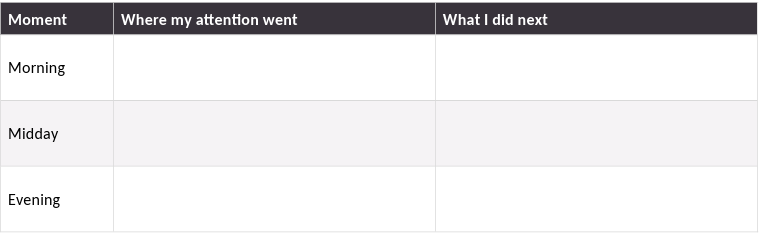
Three ordinary moments
Separate the event from the story
A story can feel as immediate as an event. Separating them gives you room to examine the story before it becomes your response. This is one way to bring Brow discernment and Throat truth into the heart.
Worked example
Return to the heart before acting
A pause can make room for a different response. In Chakrakey, bringing attention to the upper heart is an entry into that practice. The center heart then becomes the place to weigh what you will express.
1 Attend. Bring a hand or your attention to the upper chest. Breathe naturally. You do not have to call another person to mind.
2 Name. Say quietly what you are feeling or seeking. Use plain words: hurt, reassurance, fairness, rest, recognition or a clear answer.
3 Weigh. Ask what care, truth and responsibility require here. Include yourself and the people affected.
4 Choose. Name one action that serves your intention. If you need more information, make that your next action.
Optional sound practice
If you have Rick's approved audio, listen softly to the 312 Hz upper-heart entry tone. The corresponding reference tone is 624 Hz. Attention alone is enough to begin the exercise.
What changed, if anything, during my pause?
Recognize the gifts of your full spectrum
Every center contributes to a whole life. The lower centers bring survival, desire and personal power. Higher consciousness brings truth, vision and connection with Source. The heart brings these energies into relationship and expression.
| Center | Color | Gift to daily life | Hz |
|---|
Use the map without labeling yourself
A concern may involve several centers. Wanting recognition can involve personal power, belonging and communication at once. Choose the center that helps you examine the present situation; it need not become a fixed identity.
Two centers whose gifts I use readily